


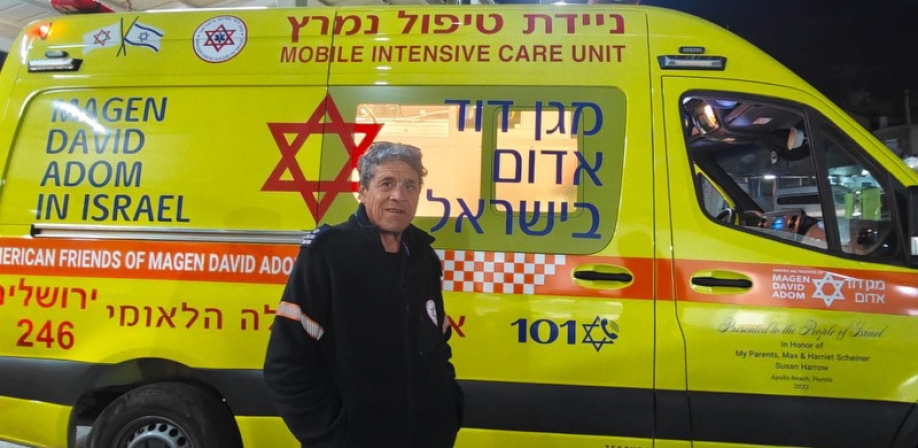
MDA EMT Dror Eini from Migdal Oz, Gush Etzion, who has been serving since 1988, was among the first responders to arrive at the scene of the direct rocket strike in Beit Shemesh on March 1st. “We were the first team on scene,” he recalls.
One home was severely damaged. Another building nearby was also hit. A large crater marked the impact site. Next door a shocking image remained, a synagogue in the area had been reduced to rubble.
The roads were covered in debris, and access to the upper part of the scene was impossible. Dror and his team had to reroute through surrounding streets and clear a path to be able to reach the area safely.
Outside one of the destroyed shelters, they located multiple casualties. Additional emergency forces, including the fire and rescue teams and the Home Front Command, started searching the structure for survivors.
In total, nine people were killed in the strike. Dozens were also wounded, luckily most of them lightly, along with two more seriously injured patients who were evacuated using ambulances.
“Even for me, this is not a regular incident. It’s not easy,” Dror says. “But when you’re inside the event, you don’t think about the severity. There’s a barrier between what you’re seeing and what you’re feeling. You focus on doing your job.”
After decades of service, Dror continues to respond wherever he is needed, including here in Beit Shemesh.
Emergency EMT Eli Eisenbach from Beitar Illit, who has been volunteering for more than 5 years in MDA, was one of the first to arrive at the scene of a direct rocket strike on March 1st in the locality of Beit Shemesh, near Jerusalem.
“It was one of the most difficult scenes I’ve had to experience in my career as a volunteer in MDA,” he says. There was significant destruction. Buildings were damaged, and more than 20 people were injured. Some were trapped under the rubble. Others required immediate medical attention and were in critical condition. Eli and his team began treating the wounded while assessing the scope of the incident.
In addition to providing immediate professional medical care, Eli was responsible for conveying accurate, continuous updates to the MDA’s Emergency Dispatch Center. “My role was to describe exactly what we were seeing and translating for the dispatchers,” he explains. “The number of casualties, the severity of injuries, the condition of the scene, that way the right resources could be deployed.” By the end of the incident, nine people had lost their lives. “It’s something you won’t be able to forget,” Eli shares.
Behind every response are paramedics and EMTs working under pressure, balancing immediate medical care with critical decision-making in real time.