


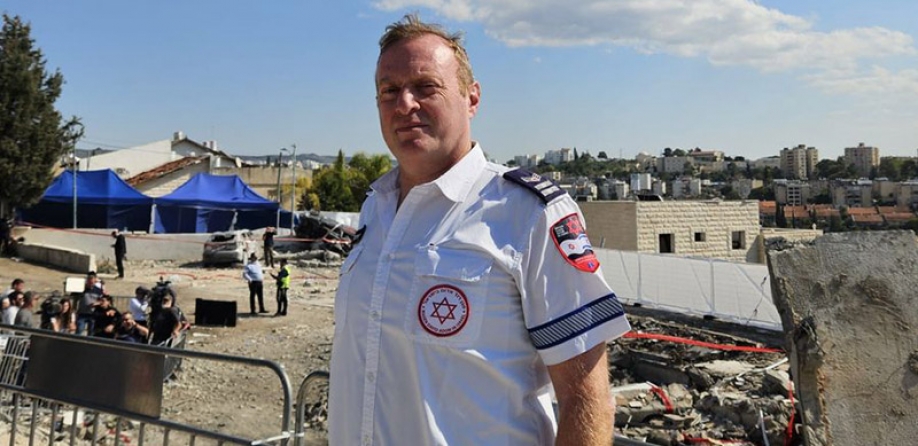
Teams operating in forty MDA ambulances responded (1.3.26) to the deadly scene in Beit Shemesh, where nine people were killed and dozens were injured. Among them was Reuven Harow, an MDA volunteer who lives in Beit Shemesh
Reuven immigrated to Israel 28 years ago. At the time, he was a young married man and father of three. One of the first things he did was report to the military recruitment office. Ultimately, however, due to his age, he was not drafted into military service.
“I couldn’t accept that,” he said. “I began looking for other ways to contribute to my country and discovered volunteering with MDA, and well, the rest is history.” Since then and to this day, Reuven now a proud grandfather, has volunteered with MDA in Beit Shemesh in a variety of roles.
On Sunday, Reuven was hosting his daughter and granddaughters at his home. He was on call with an MDA ambulance stationed near his house, ready to respond quickly to any emergency. Earlier that afternoon, he had been providing medical cover for a costume contest for children held on his street, in accordance with Home Front Command guidelines, in an effort to bring some joy to children since the Purim celebrations had been canceled.
Then the early warning Home Front Command alert came, and everyone hurried indoors.
“There was a siren. I went into the sheltered room with my wife, my daughter, and my grandchildren in their costumes. There was a nearby explosion, and we felt the blast. Not only did the windows shake, but the ground also literally moved. I understood there had been a missile strike nearby. Very quickly, the MDA dispatch center issued the instruction: ‘All first responders to their ambulances.’
“The destruction scene was massive, stretching across both sides of an amphitheater. I was instructed to go specifically to a secondary area rather than the main impact site, to scan and report. I arrived in a neighborhood hit by missile shrapnel. When people say ‘shrapnel,’ they imagine small fragments, but in these apartments, there were giant holes, through which you could see the sun. Concrete blocks and debris were scattered throughout the homes. There were no physical injuries there, thank God, but the family was in great distress. I felt uncomfortable leaving, but I knew there were casualties who needed me.”
Later, he was directed to the primary impact zone.
“About forty MDA ambulances and a tremendous number of MDA personnel - I estimate more than one hundred - were already operating at the scene. Emergency vehicles were being distributed and positioned to avoid overcrowding. From the blast wave, buildings within a wide radius were damaged, and residents had to evacuate apartments that were now unlivable. The municipality established a center to receive the displaced.”
“I parked outside the scene and entered by foot. The destruction extended across approximately three kilometers (2 miles). It was divided into four sub-areas for a more efficient command and control. I joined one of the scene commanders, the paramedic Noam Eliezer. While other teams searched for trapped victims, Noam and the MDA teams with him prepared themselves to receive casualties. They laid out stretchers in rows beside ambulances ready for rapid evacuation.
“Then a man approached me and asked for help, and I went with him. His mother was about 90 years old, a nursing-care patient connected to an oxygen tank. Her home, which was about 200 meters from the impact site, had been struck by shrapnel. There was extensive damage inside the apartment, glass and debris everywhere. Her shocked family asked to transfer her under medical supervision to other relatives. Of course, we assisted them.”
Later, as the volunteer coordinator in Beit Shemesh, Reuven received painful reminders that MDA volunteers and their families are themselves not immune to effects of war:
“I received a message that one of our volunteers was searching for five relatives who were missing at the disaster scene. Of course, we made sure a municipal social worker contacted her and that she had support, information, and assistance. I also reported that the homes of some of our volunteers had been damaged by the missile strike. One volunteer’s home was destroyed.”
Despite everything, Reuven remains optimistic: “At the most difficult scenes and in the most complex moments, you see the unity of people under distress. In the home of the elderly woman, I saw two of her granddaughters hugging each other and singing a song that says, ‘Everything will be okay.’
“To see the strength of forty MDA ambulances at a scene like this, shoulder to shoulder with security forces, rescuing, treating, and evacuating despite missile threats, knowing that there are hundreds of others responding across the whole country - that is strength. Yes, this is a challenging time, but our spirit is strong,” he concluded.